
Almost every homeowner arrives at their first interior design meeting with a folder of reference images; a marble-topped island from one home, a headboard from another, a colour palette borrowed from a hotel lobby in Bali. It’s a natural starting point. But a home built entirely from borrowed references tends to feel exactly like that: borrowed. Beautiful in photographs, oddly unfamiliar to actually live in.
The interiors that age well; the ones people still love ten years after move-in; rarely start with a mood board. They start with a conversation about how someone actually spends their days.
The Problem With Designing From “Preferences”
A preference is surface-level: “I like white cabinets.” “I want a statement chandelier.” “Can we do an accent wall?” These are useful data points, but they don’t tell a designer anything about how a family actually uses a home; whether the kitchen needs to survive three cooks moving through it at once, whether the living room needs to double as a workspace by 9 a.m., whether the “guest room” quietly functions as a study for 340 days a year.
Design built only from preferences produces a house that photographs well on handover day and slowly stops working within a year; storage in the wrong places, lighting that suits a photoshoot rather than everyday reading, a layout that looks considered but fights against how the household actually moves.
Starting With Life, Not a List
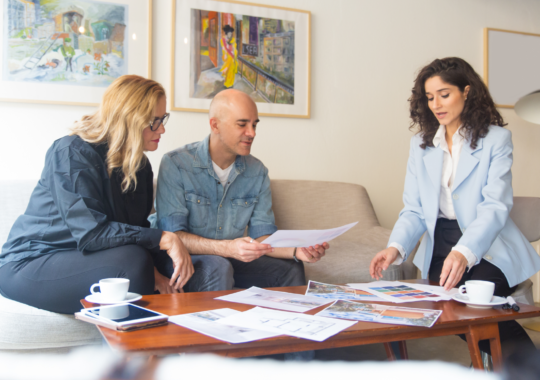
At Soudha, every interior project begins before a single material is chosen; with an understanding of routines, relationships, and how a family or a business genuinely occupies space. Do the mornings in this home involve one person or four, moving through the kitchen at the same time? Does the family entertain often, or is the living room really a private retreat? Is the home office a place for focused, closed-door work, or a spot to sit with a laptop while keeping half an eye on the rest of the house?
These questions shape decisions long before aesthetics enter the conversation; layout, storage, lighting, traffic flow. Only once that foundation is clear does style get layered on top of it.
Design Mystics: Giving a Home a Point of View
This is also why Soudha developed Design Mystics, our proprietary framework for interior design. Rather than jumping straight from a client brief to fabric swatches and finish samples, Design Mystics gives every project a clear emotional and visual direction first; a considered answer to the question, “What should it feel like to walk into this space?”; before a single material is selected.
The result is an interior that feels coherent from room to room, rather than a collection of individually pretty but disconnected choices. A home shouldn’t feel like a different design language in every room, stitched together because each space was picked from a different reference image. It should feel unmistakably like one place; and unmistakably like the people who live in it.
Why This Also Means Fewer Compromises Later
Homeowners often assume that a highly personalised process will take longer or cost more than picking off a catalogue. In practice, the opposite tends to be true. Projects that start with a clear direction make faster, more confident decisions at every subsequent stage; because there’s already an answer to “does this fit?” A pendant light, a stone finish, a furniture silhouette either supports the direction that’s already been set, or it doesn’t. That clarity removes the second-guessing and back-and-forth that usually stretches a design timeline.
It also means clients leave the design process with clarity, not compromise; a home that reflects considered decisions rather than a patchwork of trends that happened to be popular the year it was built.
Interiors That Belong to You, Specifically
A well-designed home shouldn’t need a designer’s name attached to be recognisable; it should be recognisable as belonging to the people who live in it. That’s only possible when the design process starts with their life, not with a list of finishes. Whether it’s a compact 2BHK or a sprawling independent villa, the same principle holds: understand the life first, and the interior that supports it will follow; one that still feels right to live in years after the last coat of paint has dried.



 Back to Landing Page